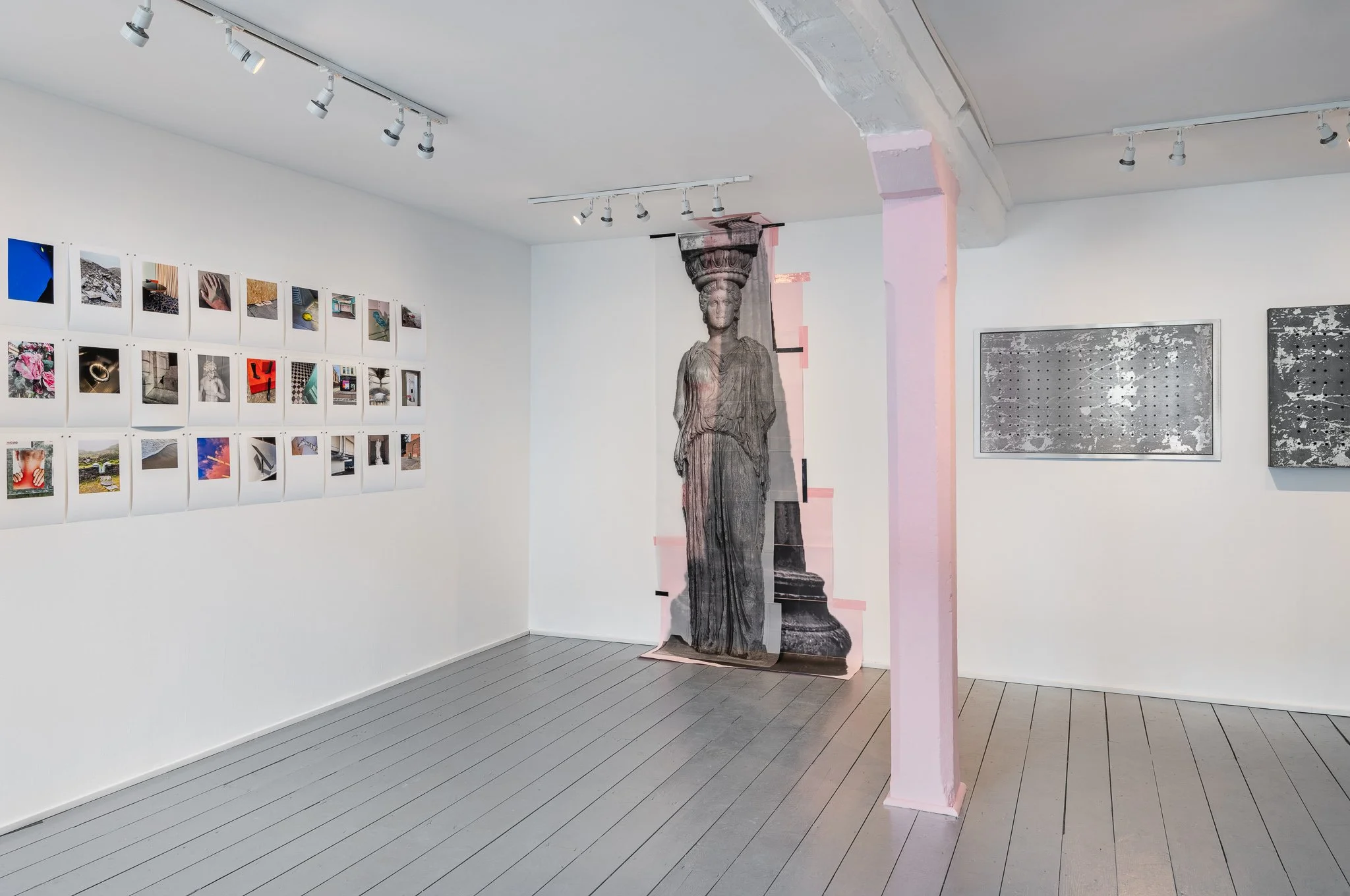
MOTH
13 March - 24 April 2026
Lynn Marie Dennehy, Andrea Newman, Pádraig Spillane
Curated by Emma Quin for Backwater Artists Emerging Curator Award 2026
Groundbreaking experiments conducted by British geneticist Bernard Kettlewell, building on the earlier work of J.B.S. Haldane, explored the evolutionary changes of the British moth in highly polluted areas. In the 1800s, a black form of the originally white peppered moth began to appear across industrial areas of the UK. This phenomenon, later termed ‘industrial melanism’, created three new species of moths that were darkened in colour due to consistent exposure to pollution in industrial areas, changing their colour from bright amber and white to dark brown. Soot and ash from factories had blackened the tree trunks of the moth’s habitat. This was discovered 10 years before the concept of natural selection was brought forth by Charles Darwin.
Moths are an impeccable example of adaptive behaviours. They seamlessly blend into their environment, assuming the colour and pattern of any surface to camouflage themselves from predators. They are naturally drawn to places that match their colouring, and during rest, they position their body to further blend into their environment.
Human evolutionary social behaviours do not differ much from those of the moth. Most sociological thinkers, like Chris Cooley, argue that humanity does not exist in a vacuum; rather, the self is created in response to society. Thus, society and the individual are not separate, but rather two complementary aspects of the same phenomenon.
Moving from childhood to adulthood, the individual assimilates into mass culture, regulating their identity and behaviour. Whilst learning expected modes of behaviour can guide us towards what is ‘safe’ and ‘acceptable’ in society, it is hard not to ask what is lost during this process. As the systems of capitalism construct our material reality, what delightfully rough edges of the self are smoothed over by these wider forces? What parts of our innate being are deemed unsavoury, and how does that happen to align with the socio-political, imperial and cultural biases of our time?
Foucault’s theory of panopticism asserts that individuals can be controlled when they believe themselves to be under constant surveillance, even if no one is watching. Whilst classic panopticism draws from the constructions of prisons and military facilities, Conor Sheridan adapts this theory for our modern times. Information systems and digitised forms of surveillance are creating a new form of decentralised panopticism that we self-enforce.
Perhaps by externally observing patterns of survival in other species, we can see our own social conditioning more clearly. By interrogating the societal constructions we reinforce, reproduce and perform, often without knowing, this creates room for more expanded, authentic ways of living to emerge or take flight.